Before you send
| Material | Composition, and whether the object is a stretch fiber, another filament, or a reinforcement |
|---|---|
| Method | Standard, version and specimen state when a number is already in your file |
| Scope | Which result, grade phrase or handling question needs review |
A street address, a switchboard number and published opening hours are not listed for this Hyosung fiber desk. The form is the route. If you want a return call, put your own telephone in the form. Do not expect a planted office pin or a social account from this page.
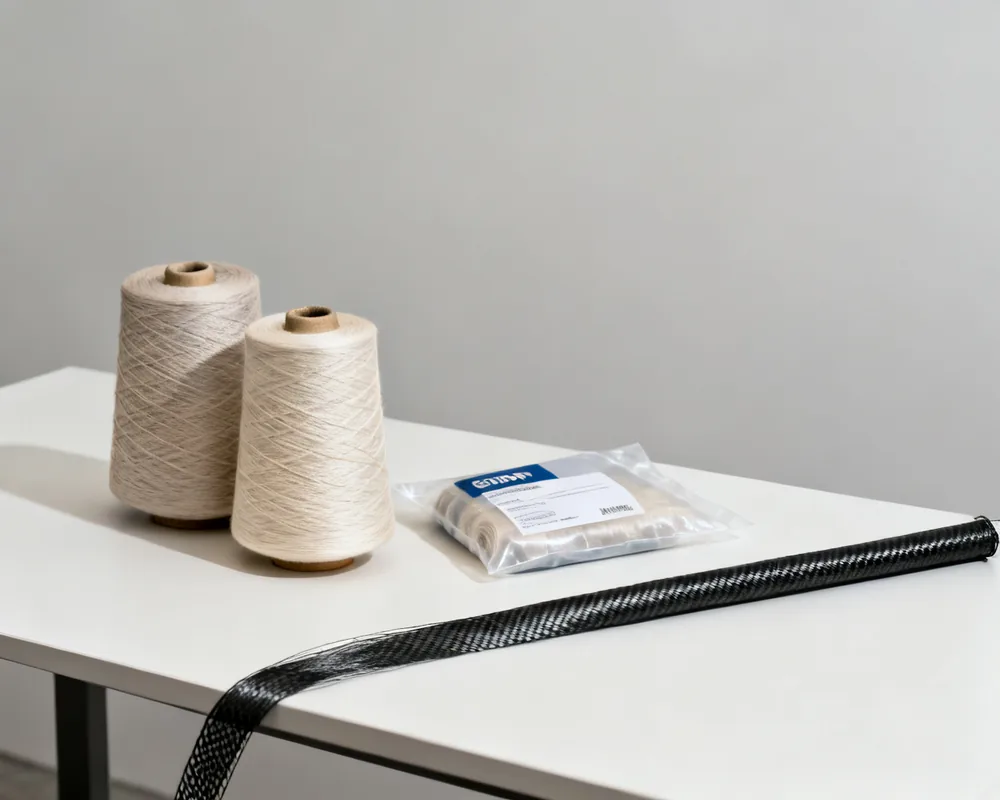
For stretch fiber development, add denier or dtex, the host yarn or fabric, and the care or elongation context you care about. Denier is grams per 9,000 metres and dtex is grams per 10,000 metres; write one unit, not both, unless you are showing the conversion yourself. For hyosung carbon fiber, add the form you mean and keep a phrase such as hyosung h3065 carbon fiber t1000 grade attached to the document that used it. Destination and quantity can sit in the same message, marked as discussion figures. A quantity is not a minimum, and a date you hope for is not a published lead time.
Shade references, lab dips and bulk cones answer different questions. Say which one you are holding. Batch traceability, if you need it, is a request for the identifier that links that specimen to a proposed order, not a statement that the identifier already exists.
If the downstream item is already a cloth, add the GSM target in g/m² and the usable width in centimetres, and keep the selvedge out of the cuttable figure. A 150 cm usable width is not a 150 cm full width if each selvedge takes additional cloth. If it is still a fiber, leave those cloth fields blank and stay with linear density plus supply format. Composition, if you already know it, should be written as percent by mass summing to 100. That split prevents a knit weight from being read as a property of the cone.